
DEVB requirement, June 2026
Body-worn cameras (BWVC) for Hong Kong public works inspections
Since June 2026, DEVB requires frontline resident site staff and contractors' frontline staff on all public works contracts to wear body-worn video cameras (BWVC) during site inspections. Kodifly's kit is an Insta360 X6 360 camera on the safety helmet, the SpatialSense app on the inspector's phone, and a dated inspection record in SpatialSense, linked to the DWSS.
An Insta360 X6 on the helmet, the SpatialSense app on the phone, one dated record in your DWSS.
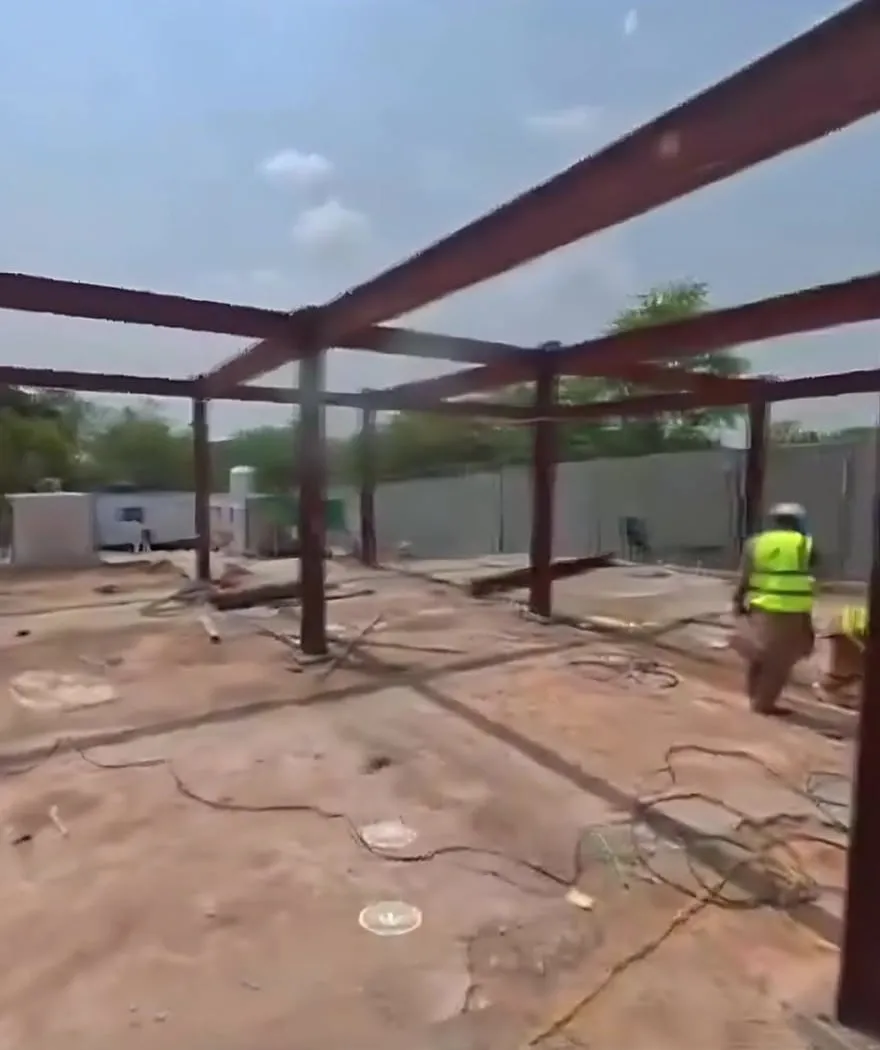
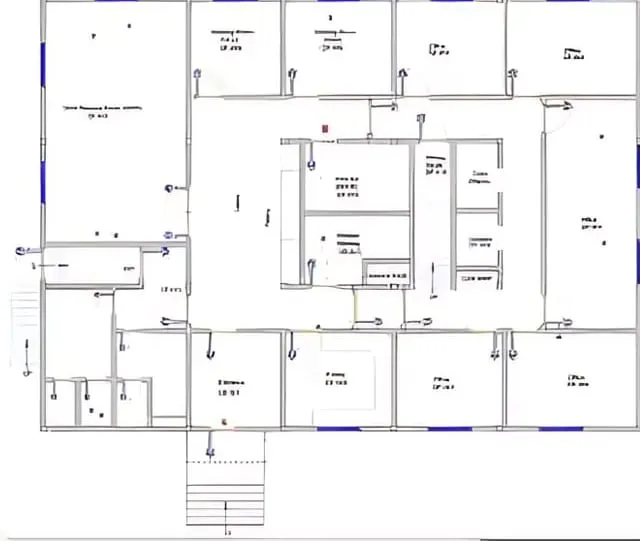
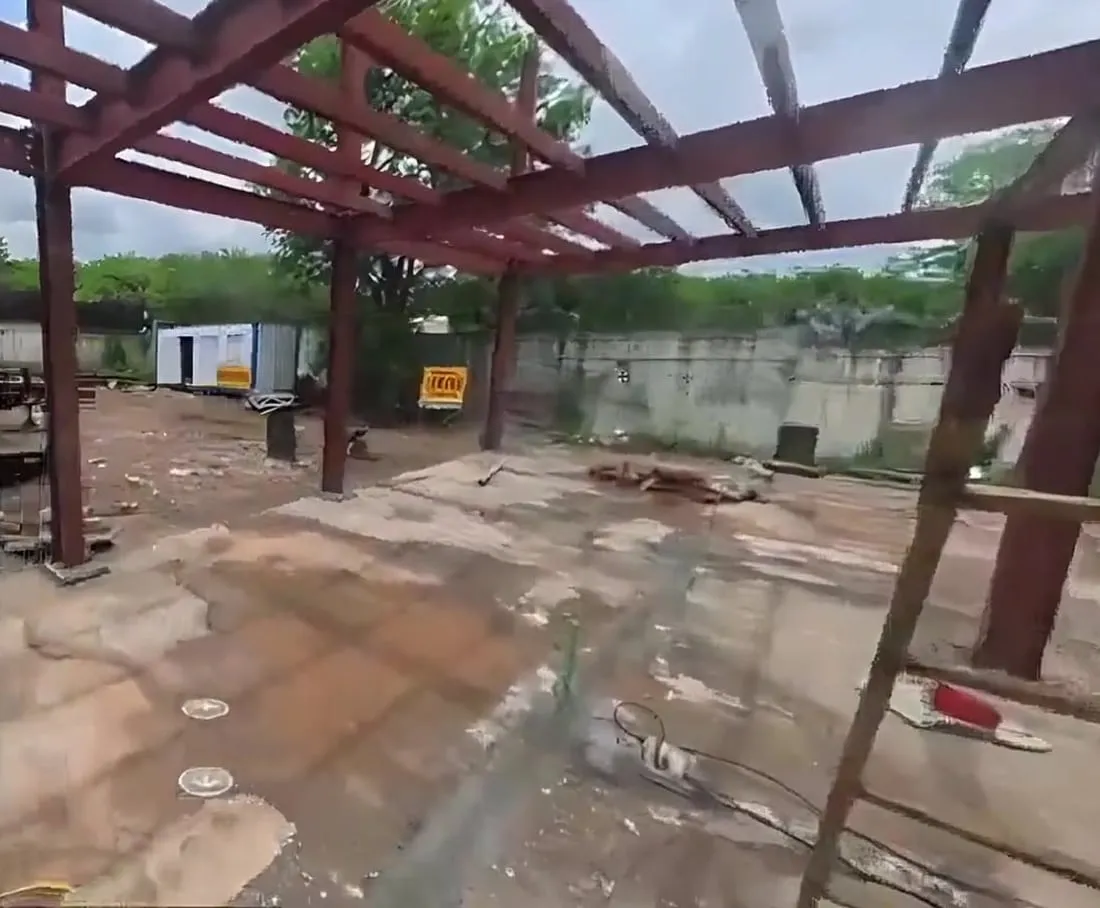
- Requirement
- BWVC during site inspections on all public works contracts, since June 2026
- Camera
- Insta360 X6 on the safety helmet: 8K 360 video, 196 g
- Kit
- 256GB card, batteries, charger, USB-C power pack and bilingual notice
- App
- SpatialSense for iOS and Android, installed by Kodifly
- Record
- Dated, on the floor plan, linked to the RISC form and site diary
- Footage
- Kept at least 7 days, given to the Client and Project Manager within 24 hours
- 360°
- view of the whole scene, not only where a chest camera points.
- 196 g
- Insta360 X6 on the helmet, under the 400 g contract limit.
- 4
- DEVB purposes covered, from supervision to progress.
- 1
- dated record, linked to your DWSS.
Worn on the helmet, on real inspections.
The camera sits on top of the safety helmet. Both hands stay free, and the whole scene is recorded, not only what is in front of the chest.
- Nothing to aim, and both hands free during the walk
- Every direction recorded in one walk
- Started and stopped on the camera or from the app
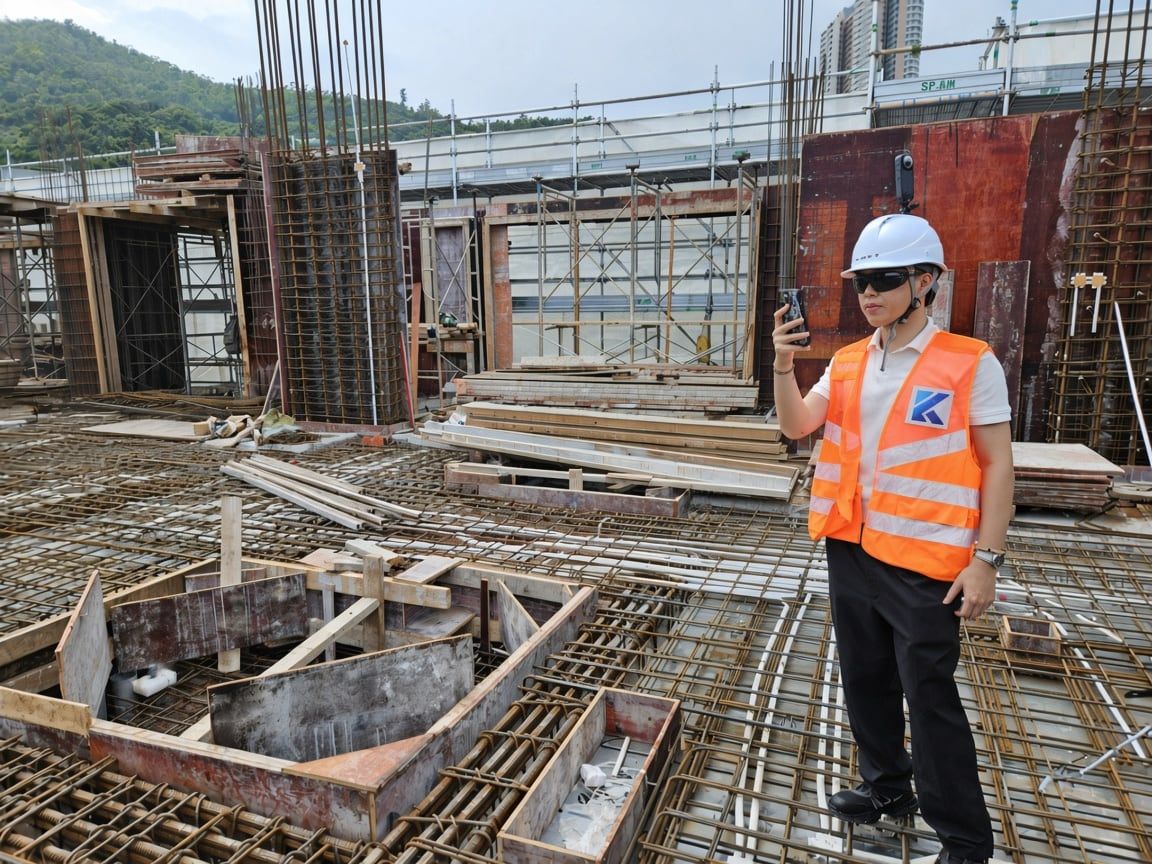
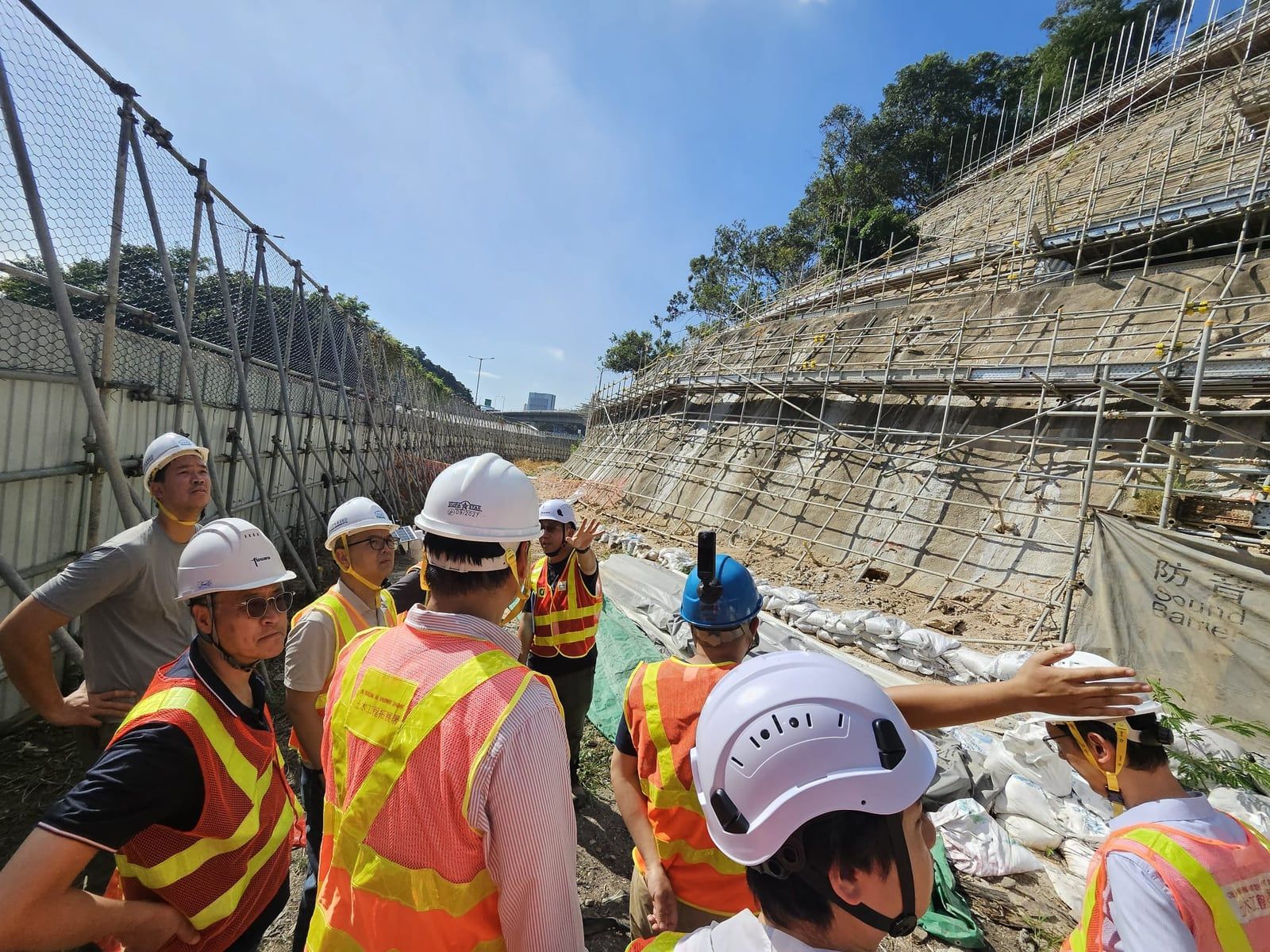
A Kodifly engineer walks a rebar deck before the pour, camera on the helmet and phone in hand.
The main contract items, covered.
Full list in the specification guide
Worn during site inspections
Resident site staff and contractors
1080p30 or higher with audio, 9 hours of power
Bilingual recording notice
Site supervision record
Safety management
Quality control
Works progress monitoring
Secure footage and audit trail
Linked to the DWSS
The kit: an Insta360 X6 on the helmet.
Kodifly supplies the camera, fits it to the helmet and sets it up for your contract. Each wearer gets one kit.
- Insta360 X6: 8K 360 video, 196 g, dust and water sealed
- Helmet mount, with a chest or shoulder strap option
- 256GB microSD card, V30
- Batteries, charger and a USB-C power pack for 9 hours of recording
- Bilingual notice: Video & Audio Recording In Progress 錄影及錄音現正進行中
- SpatialSense app for iOS and Android
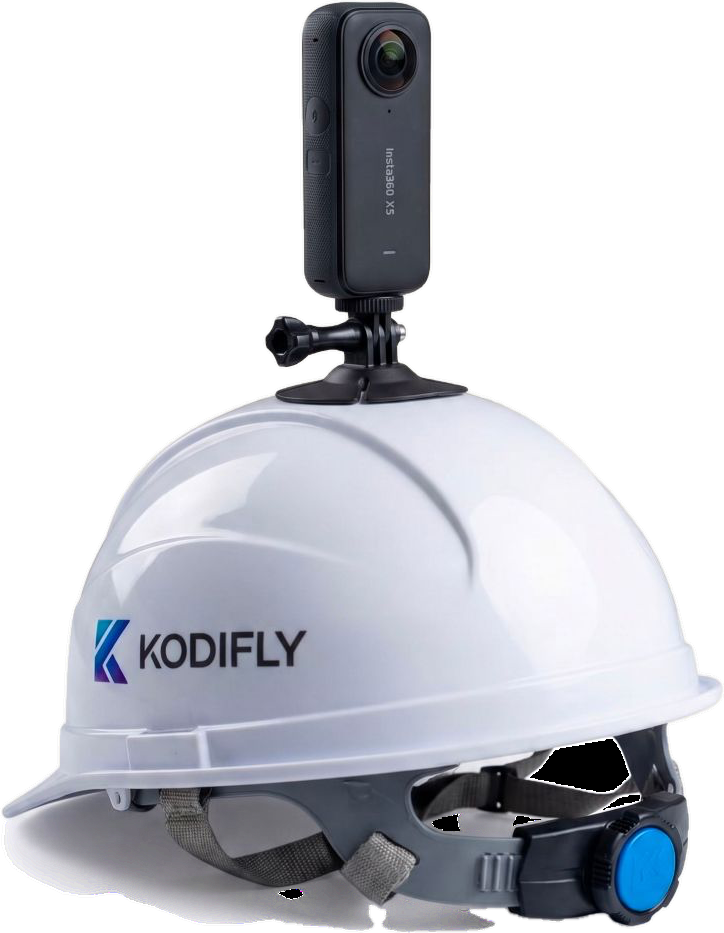
The photo shows the earlier X5, without the notice label. Kits now ship with the X6. SpatialSense also works with the X5, the X4 and the DJI Osmo 360. Camera figures are Insta360's.
An Insta360 X6 on its own, or the Kodifly system?
Kodifly sells the X6 on its own too, so it is a fair question. The camera is the same, and you can add a card, a power bank and a notice yourself. The difference is what happens after the recording, and who carries the contract duties.
| What the contract asks for | An Insta360 X6 on its own | The Kodifly BWVC system |
|---|---|---|
| The camera | Insta360 X6: 8K 360 video, 196 g | The same X6, fitted to the safety helmet |
| Storage, at least 256GB | 64GB built in. A card is extra | 256GB V30 microSD card fitted |
| Battery, 9 hours of recording | About 200 minutes at most on its own battery, by Insta360's figures | A USB-C power pack in the kit covers the 9 hours |
| Recording notice | None supplied | Bilingual notice on the helmet |
| Getting footage off the camera | Copy files from the card, or use Insta360's own app | The SpatialSense app pairs with the camera and sends each walk to the project |
| Where the footage is kept | Files in folders on a laptop or a drive | In the project: dated, on the floor plan, with a capture ID |
| Link to the inspection | None | Each walk is linked to its RISC form or site diary entry |
| Kept at least 7 days, deleted 7 days after completion | Tracked by hand | Held in the project and deleted 7 days after completion of the works |
| Footage to the Client and Project Manager within 24 hours | Send a file by hand | Shared from the record, with the time logged |
| Access list and audit trail | None | Project login, named access and a log of who opens footage |
| Faces blurred before training use | Edit each video by hand | Face blur in SpatialSense |
| AI findings | None | Safety and quality findings drafted for the engineer to review |
| Implementation plan, briefing and training | You write and run them | Kodifly drafts the plan and trains the wearers |
| Support | The maker's retail warranty | Support within 2 days and a replacement during any breakdown |
Camera figures are from Insta360's published X6 specification. Contract items are from recent Hong Kong public works contract specifications. Read your own clause, because the contract you sign governs.
One app runs the cameras.
The SpatialSense app for iOS and Android manages the cameras, saves each walk and sends it to your SpatialSense project. Kodifly installs it for your team.
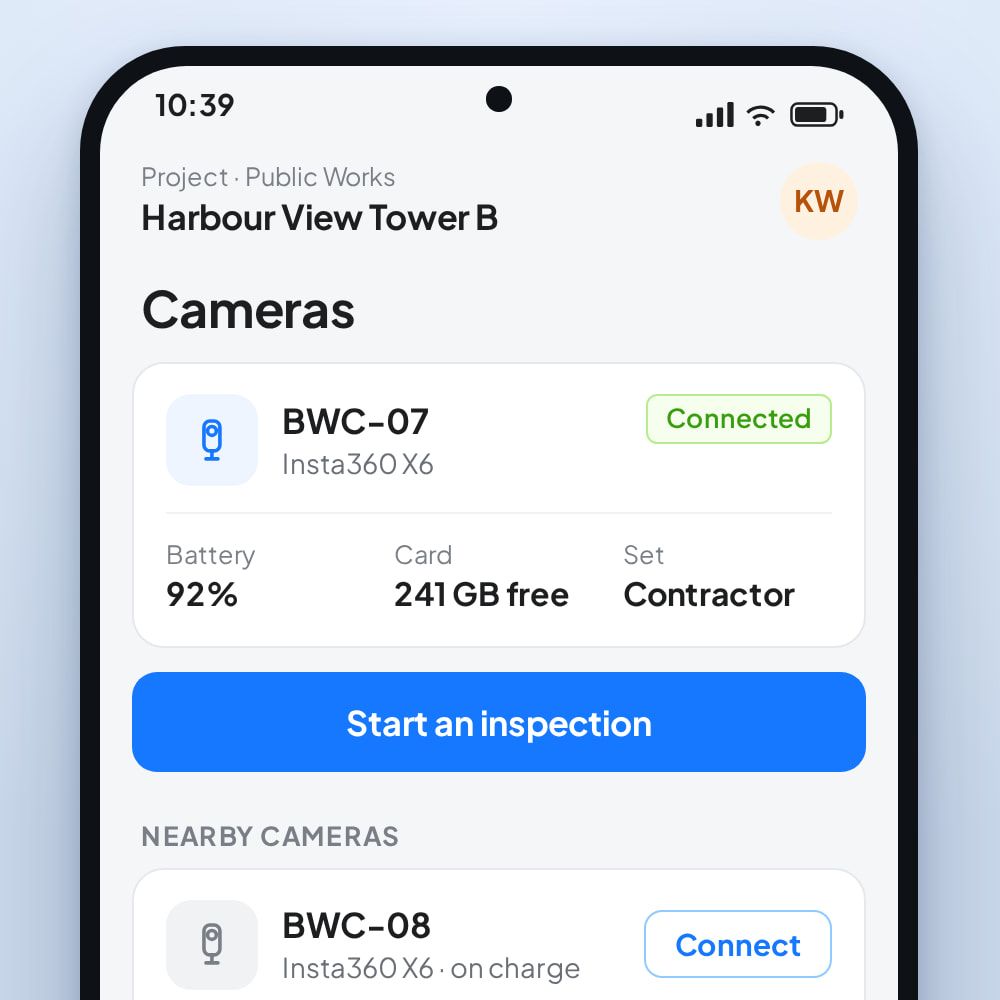
Pair the camera
The app connects to the camera in two taps. It shows which camera you hold, its battery and its card.
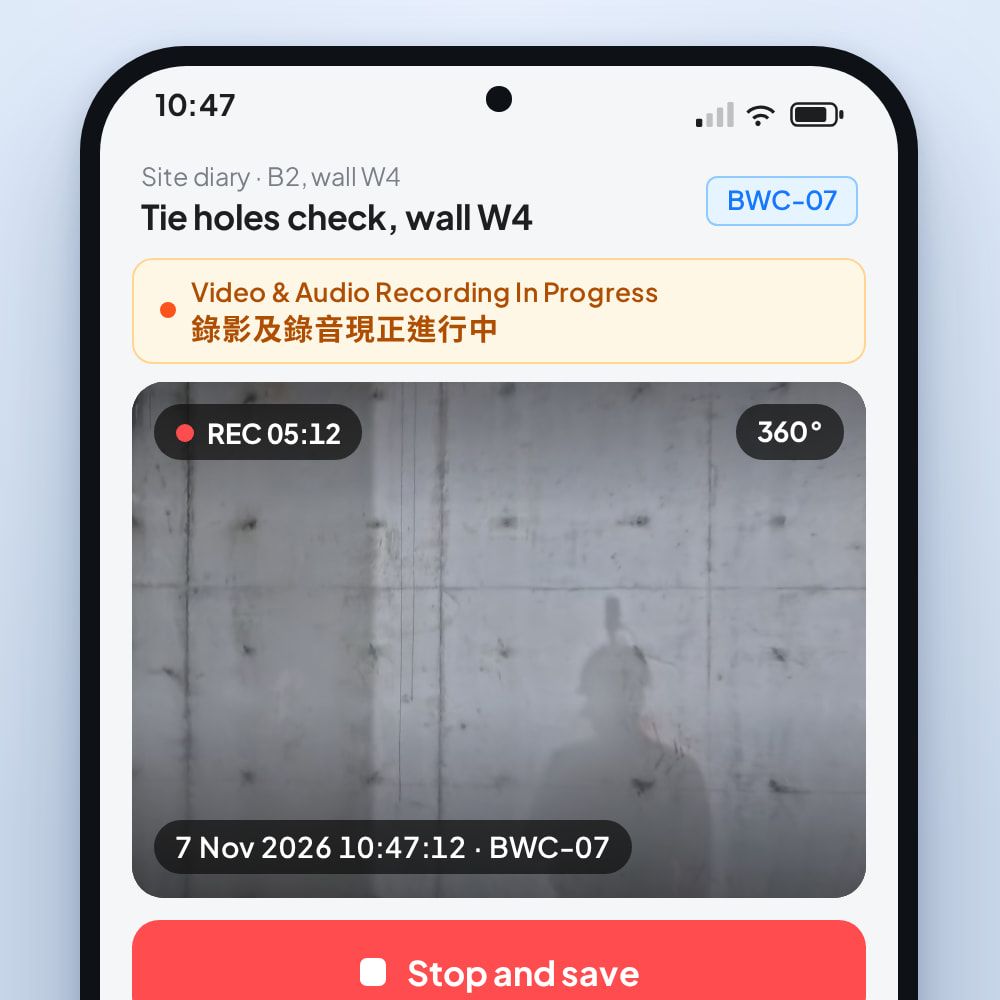
Record the inspection
Start and stop from the phone. The date, time and camera number are on the picture.
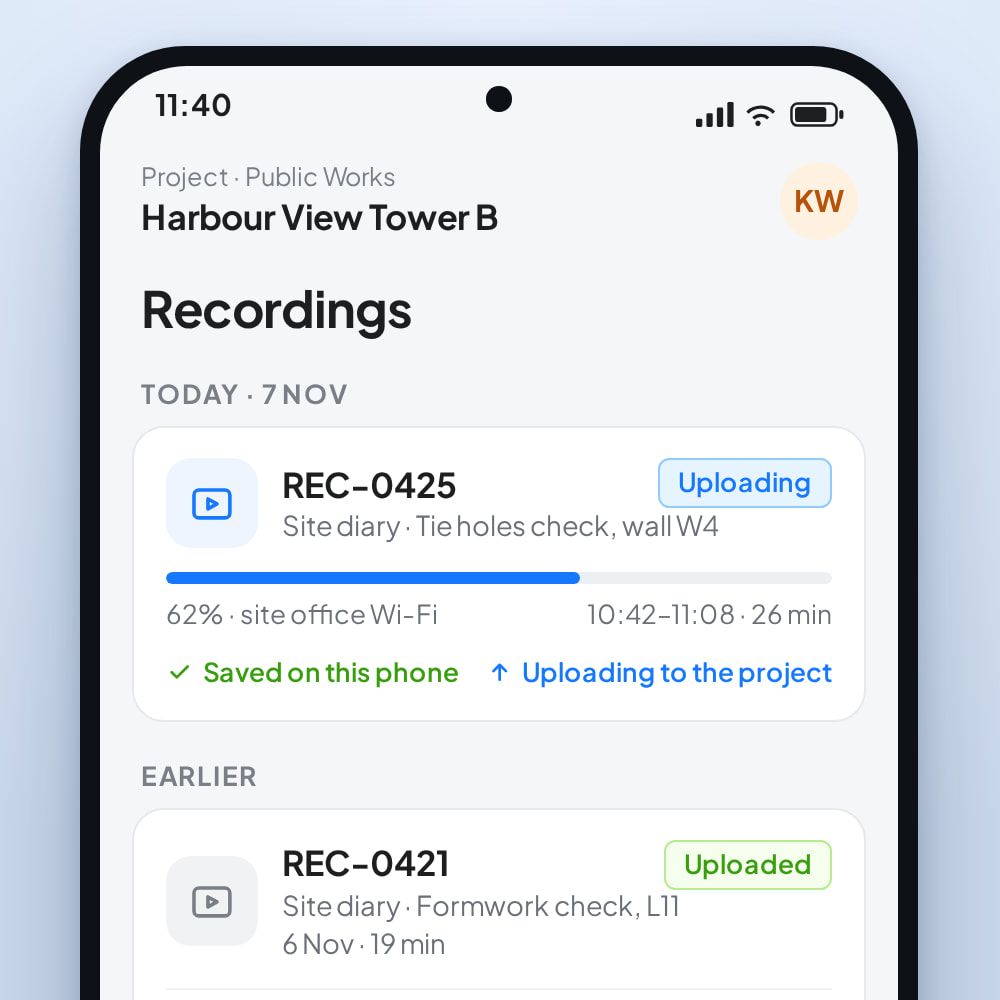
Saved to the project
Each walk is saved on the phone, then sent to SpatialSense. No cards to copy by hand.
Send us your body-worn camera clause
Talk to us about body-worn camerasFrom helmet to signed-off record.
Pair the camera
Two taps in the app, at the start of the inspection.
Walk the works
Hands free. One walk covers the zone.
Saved to the project
Dated, on the floor plan, with a capture ID.
AI drafts the findings
Safety and quality findings, for review.
The engineer signs off
The record joins the DWSS.
Guides and detail pages
Contract specification
The BWVC specification Hong Kong public works contracts now set: 400 g or less, 256GB, 9 hours of 1080p30 with audio, 7-day retention. Kodifly meets each item.
Footage and privacy
Body-worn camera footage of identifiable people is personal data under the PDPO. PCPD guidance applied to site footage, with a policy checklist.
Inspection workflow
A step-by-step site inspection video record workflow, from start of shift to retention. Footage is dated, placed on the floor plan and linked to DWSS records.
Requirement explained
DEVB has required body-worn video cameras on public works site inspections since June 2026. Who wears them, from when, why, and what your contract adds.
Where the footage goes in the DWSS
Every recording in one register.
Each walk is listed with its camera, its wearer and the inspection it belongs to. When the Project Manager's office asks for a recording, the designated person shares it from the same page.
- Given to the Client and the Project Manager within 24 hours
- Kept at least 7 days and deleted 7 days after completion
- Named access, with a log of who opens footage
- Faces blurred before any training use
Body-worn camera questions
Are body-worn cameras required on Hong Kong construction sites?
On public works, yes. Since June 2026 DEVB requires frontline resident site staff and contractors' frontline staff on all public works contracts to wear body-worn video cameras (BWVC) during site inspections (LC Paper CB(1)749/2026(02), paragraph 40). Private sites follow their client's contract, and Kodifly delivers the same system for both.
Who has to wear the body-worn camera?
The frontline personnel of the resident site staff and of the contractors. The duty is for site inspections, not for a whole shift.
Since when does the body-worn camera requirement apply?
DEVB says it has applied since June 2026. The Secretary for Development announced it in a written reply to the Legislative Council on 24 June 2026 (LCQ13, "Smart monitoring of site safety", on info.gov.hk and devb.gov.hk).
Does Kodifly deliver body-worn cameras for public works?
Yes. Kodifly delivers the Insta360 X6 helmet camera kit, the SpatialSense app, the dated inspection record on the floor plan, AI findings for engineer review, and the link to the DWSS, as one system.
Which camera does Kodifly use as the body-worn camera?
The Insta360 X6, a 360 camera that records 8K video and weighs 196 g, on a mount on top of the safety helmet. The kit adds a 256GB card, batteries, a charger, a USB-C power pack and the bilingual notice. SpatialSense also works with the Insta360 X5 and X4 and the DJI Osmo 360.
Why not just buy an Insta360 X6?
You can, and Kodifly sells the camera on its own. A camera alone gives you video files on a card. The contract also asks for an implementation plan, a notice, 7 days of secure retention, footage for the Client within 24 hours, an access list and deletion 7 days after completion. The Kodifly system does those, and links each walk to its RISC form and site diary entry.
Does the Insta360 X6 battery last 9 hours?
Not on its own. Insta360 gives about 200 minutes at most for the X6's own battery. The Kodifly kit adds a power pack that feeds the camera over USB-C, for the 9 hours of recording that current contracts ask for. The power set-up goes in the implementation plan, for the Project Manager's acceptance.
Is there a mobile app for the cameras?
Yes. The SpatialSense app runs on iOS and Android. It pairs with the camera in two taps, saves each walk on the phone and sends it to your SpatialSense project. The camera also records from its own button. Kodifly installs the app for your team.
What does DEVB say the cameras are for?
Four purposes, site supervision, safety management, quality control and works progress monitoring. In SpatialSense each walk is dated, placed on the floor plan, read by AI and linked to the inspection request and site diary.
Is there an official specification for the camera?
DEVB publishes no central specification. Government contracts now set one, and this page follows the current contract requirements. Recent public works contract specifications ask for a camera of 400 g or less with at least 256GB of storage and 9 hours of 1080p30 recording with audio. The contract specification guide lists every item, and shows how the kit, SpatialSense and Kodifly's service meet each.
Can a 360 helmet camera count as a body-worn camera?
It can be proposed. Current contract specifications ask for chest or shoulder straps or an equivalent, and say a camera that integrates with a smart safety helmet may be proposed if it meets the rest of the clause. Kodifly's kit puts an Insta360 X6 on the helmet, worn hands-free, and the mount goes in the implementation plan for the Project Manager's acceptance. A chest or shoulder strap is available if the Project Manager prefers it.
How is the footage kept and who can see it?
Current contracts require footage to be stored securely for at least 7 days, given to the Client and Project Manager within 24 hours of a request, and deleted 7 days after completion of the whole of the works. SpatialSense does each, behind the project login with an audit trail. The PDPO and PCPD's Monitoring and Personal Data Privacy at Work guidelines apply.
Is a body-worn camera part of the Smart Site Safety System (4S)?
No, it is a separate DEVB requirement. TC(W) No. 3/2023 lists smart devices such as helmets and wristbands that track location and standstill, and AI cameras. Kodifly delivers both on one platform.
How is it different from confined-space video and the Co-supervision Platform?
Confined-space entrance video is a Labour Department rule, in effect since 30 November 2024, to record at the entrance and exit for the whole work period and keep it for one year (paragraph 12.7). The Co-supervision Platform under TC(W) No. 1/2026 applies to capital works above HK$400 million and can take body-worn camera data as an input. Kodifly delivers all three.
Send us your body-worn camera clause
Tell us the contract and clause. We will show you the system, point by point, before the demo.