
DEVB TC(W) No. 8/2025
Digital Works Supervision System (DWSS) on SpatialSense
DWSS stands for Digital Works Supervision System, the web and mobile system DEVB requires on Hong Kong capital works contracts above HK$30 million tendered from 1 April 2026. SpatialSense is Kodifly's DWSS, built to Annex A of TC(W) No. 8/2025 with all six mandatory modules live, plus AI search and 360, drone and LiDAR capture in the same record.
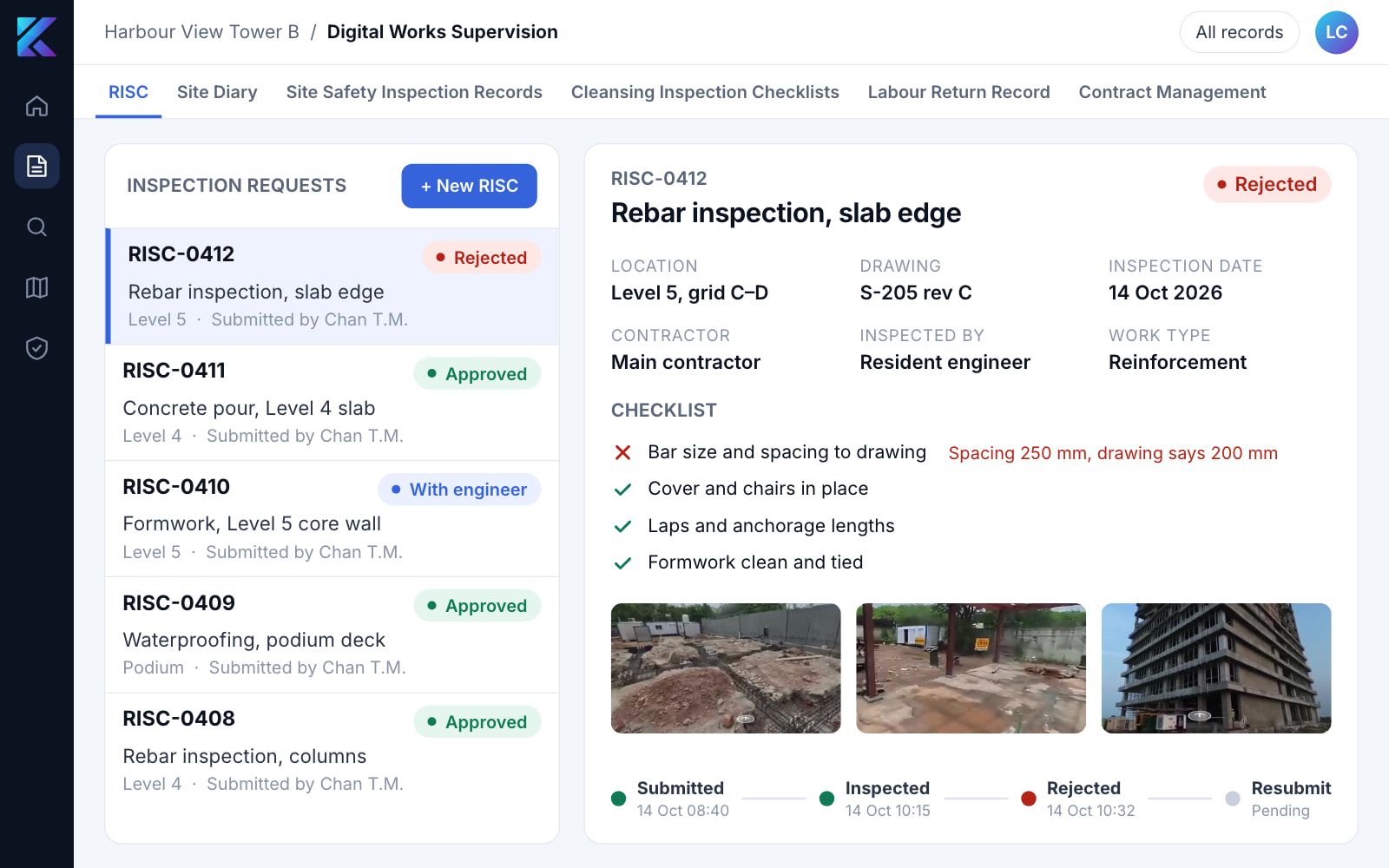
Six mandatory modules, mapped to SpatialSense
Annex A, section 7.5 lists six modules. Each is live in SpatialSense.
| Module | What Annex A requires | In SpatialSense |
|---|---|---|
| Request for Inspection / Survey Check (RISC) | Submit and re-submit requests until the inspection is certified complete, with linked history, photo records and a status dashboard covering overdue actions, pass and fail rate and process time. | Live |
| Site Diary / Site Record Book | Record, review and endorse progress, plant and labour, weather, site photos and occurrences affecting works, with statistics on overdue actions, labour and plant, weather and instructions. | Live |
| Site Safety Inspection Records | Weekly and monthly safety and environmental inspection checklists and safety performance records, with non-compliance logging across the whole inspection cycle. | Live |
| Cleansing Inspection Checklists | Daily and weekly cleansing checklists and a cleanliness performance record, with photos and tracking of non-compliance and remedial works. | Live |
| Labour Return Record | All data fields of G.F. 527, automatic calculation of project fields and dates, and automatic retrieval of labour data from the Site Diary. | Live |
| Contract Management | Compensation events, Project Manager's Instructions, early warnings, programme and payment workflows, key contract information and NEC Health Check data. | Live |
Why SpatialSense for your DWSS
Four things a project office can check against the circular and the demo.
Built to the current circular
SpatialSense is built to Annex A of TC(W) No. 8/2025, which superseded TC(W) No. 2/2023, with all six mandatory modules live, including Contract Management with NEC Health Check data.
AI built in
Ask your site records a question in plain language and get a summary with links to the source records. Annex A 1.5 asks the contractor to incorporate AI within the DWSS.
Capture in the same record
360 walks, drone flights and LiDAR scans land in the same dated record as the diary and inspections, so a finding stays attached to the photo it came from.
Complete on its own
SpatialSense meets the DWSS requirements without other Kodifly products. If the contract also asks for a Smart Site Safety System, SpatialSense provides its centralised platform and digital permit-to-work.
The DWSS is the hub. The other circulars connect to it.
Capture, safety, drone, AI and BIM work all link back to the one dated record.
DWSS
The hub: TC(W) No. 8/2025
TC(W) No. 1/2026
TC(W) No. 3/2023
TC(W) No. 9/2025
TC(W) No. 3/2026
TC(W) No. 1/2025
Capture
Findings tied to the place they came from.
Pin an issue in the 360 view and assign it. Each finding stays attached to its photo and date, from the walk to the report.
The requirement at a glance
- Circular
- DEVB TC(W) No. 8/2025, issued 12 December 2025. It supersedes TC(W) No. 2/2023.
- Applies to
- Capital works contracts, including capital subventions contracts under Head 708, with a pre-tender estimate above HK$30 million and tendered on or after 1 April 2026.
- Earlier contracts
- Contracts tendered before 1 April 2026 implement the enhancements as far as practicable.
- Other contracts
- Bureaux and departments should adopt it as far as practicable in other works contracts, such as maintenance and term contracts.
- Budget guide
- Normally not more than HK$1.5 million or 1% of the pre-tender estimate, whichever is higher, with a cap of HK$10 million. Exceeding it needs approval from an officer at D2 rank or above (paragraph 12).
- Delivery
- Live demonstration within one month of commencement, proposal within eight weeks, and commissioning within three months, or as agreed with the employer's representative (Annex A, 3.1).
- Data
- Data is available to third-party applications, including the Integrated Capital Works Platform (iCWP), through an API within 24 hours (Annex A, 1.7.2).
- Handover and audit
- The DWSS is handed over to the employer at completion, and its proper use is a standard item in technical audits (paragraphs 15 and 16).
Three core components
The circular defines the DWSS as three components working together.
Workflow Management
Digitalised processing of the mandatory forms and records in one centralised database, through six mandatory modules.
Smart Construction Management
The data hub that collects and consolidates data from smart site applications to monitor safety, progress, deformation, material, machinery and environment. The smart site applications themselves are not part of the DWSS.
Smart Document Management
Centralised storage, organisation and management of formal project documents, with review workflows and external reviewer support. It replaces the separate Electronic Document Management System (EDMS).
What else a DWSS must do
Beyond the six modules, Annex A sets requirements a project office should test in every proposal. SpatialSense is built to meet them.
| Area | Requirement | Annex A |
|---|---|---|
| Access | Web browser on desktop or laptop over HTTPS with no extra software, plus a native iOS and Android app. Traditional Chinese display if the employer's representative requests it. | 1.6 |
| Security | At least 256-bit SSL for network communication, encryption in transit and at rest, IT security audits and audit trails. | 4.1 to 4.3 |
| Backup and availability | Scheduled backups, an off-site backup of full system data, 99.9% uptime during working hours and a disaster recovery plan. | 2.4, 4.2 |
| Data and integration | Data stored in its original format and available to third-party applications through an API. Selected data standardised for iCWP according to DEVB's Data Standardisation Report. | 1.7, 11.1 |
| AI | The contractor incorporates appropriate AI within the DWSS and documents it in the proposal. The Inventory of AI use cases sets the mandatory requirements. | 1.5 |
| Project team | The employer appoints a professional-rank project team member and a resident site staff member to manage the DWSS. | 3.2 |
Read with these circulars
The DWSS is the hub. Its Smart Construction Management component collects data from the smart site applications on a project, so a specification is usually written against several circulars at once.
TC(W) No. 1/2026
Co-supervision Platform
4D LiDAR capture for remote supervision, connected to the DWSS hub.
TC(W) No. 3/2023
Smart Site Safety System
The centralised management platform may be amalgamated with the DWSS.
DWSS tender checklist
Test a DWSS proposal against the circular before tender and at acceptance. The groups follow the order of the circular and Annex A.
Before tender, for project offices and consultants
- Confirm the contract is a capital works contract with a pre-tender estimate above HK$30 million, tendered on or after 1 April 2026 (paragraph 8).
- Write the contract specification from the Annex A reference specification, and seek approval of the DWSS specification from the Approval Officer under the Project Administration Handbook (paragraph 11).
- Do not require a separate EDMS. Smart Document Management replaces it (paragraph 11).
- Compare the estimated cost with the guide of HK$1.5 million or 1% of the pre-tender estimate, whichever is higher, capped at HK$10 million (paragraph 12).
- Allow for site conditions, including supervisory staff establishment and mobile network and Wi-Fi provision on site (paragraph 11).
Contractor proposal, within eight weeks
- Design of the forms, records, reports and dashboards.
- Workflow processes and the allowable time to complete each action.
- Interfacing protocols with the smart site data systems.
- Platform architecture and network configuration.
- Hosting environment, with independent auditor reports where the system is hosted in a data centre or the cloud (2.3.2).
- Schedule of system delivery and user acceptance criteria.
- Backup and disaster recovery plan, and security assurance plan.
- Any AI features, documented and compliant with the employer's data privacy and security policies (1.5.2).
Acceptance of the six mandatory modules
- RISC: re-submission until certified, linked inspection history, photo records, status dashboard.
- Site Diary: record, review and endorse workflow, with the required record content and statistics.
- Site Safety Inspection Records: weekly and monthly checklists, performance records, non-compliance cycle.
- Cleansing Inspection Checklists: daily and weekly checklists and the cleanliness performance record.
- Labour Return Record: every field of G.F. 527, with labour data pulled from the Site Diary.
- Contract Management: compensation events, instructions, early warnings, programme, payment and NEC Health Check data.
Access, security and availability
- Works in a desktop browser over HTTPS with no extra software, and as a native iOS and Android app (1.6).
- At least 256-bit SSL, with data encrypted in transit and at rest (4.1).
- Scheduled backups and an off-site backup of full system data, including audit trails and logs (4.2).
- 99.9% uptime during working hours, and a disaster recovery plan (2.4).
- User account management, authentication and access rights as set out in Annex A section 5.
Data, handover and audit
- Data is stored in its original format and available to third-party applications, including iCWP, by API within 24 hours (1.7.2).
- Selected data is standardised for iCWP according to the Data Standardisation Report (paragraph 17).
- A professional-rank project team member and a resident site staff member are appointed to manage the DWSS (3.2).
- The system is handed over to the employer at completion (paragraph 15).
- Expect a standard item on the proper adoption and use of the DWSS in technical audits (paragraph 16).
What the circular asks of the contractor
The delivery schedule in Annex A 3.1, in order.
Within one month
Propose the DWSS and give a live demonstration for the employer's representative to approve.
Within eight weeks
Submit the DWSS proposal covering forms and dashboards, workflows, smart site interfaces, architecture, hosting, delivery schedule, acceptance criteria, backup and disaster recovery, and security assurance.
Within three months
Commission the DWSS, unless another period is agreed with the employer's representative.
DWSS questions
What is a DWSS?
A Digital Works Supervision System is the web-based portal DEVB requires on Hong Kong capital works contracts above HK$30 million tendered on or after 1 April 2026. It digitises the mandatory site forms and records (RISC, site diary, safety and cleansing inspections, labour returns and contract management), collects data from smart site applications, and holds the formal project documents (paragraph 9, Annex A 1.1).
What changed between TC(W) No. 2/2023 and TC(W) No. 8/2025?
Paragraph 6 lists four key improvements. A Smart Document Management component replaces the separate EDMS. The Contract Management module adds NEC Health Check data. The circular sets project team requirements for managing the DWSS. And contractors adopt AI technologies within the DWSS.
Which DWSS systems are available in Hong Kong?
Several vendors offer systems for Hong Kong public works. The circular sets requirements rather than naming products, so compare each proposal against Annex A. The tender checklist on this page follows the order of the circular for that purpose.
How soon must a DWSS be running after the contract starts?
Annex A 3.1 asks for a live demonstration within one month of commencement, a proposal within eight weeks and commissioning within three months, or as agreed with the employer's representative.
Is SpatialSense a complete DWSS on its own?
Yes. SpatialSense is built to the DWSS requirements in TC(W) No. 8/2025, with all six mandatory modules live, without other Kodifly products.
Do we still need a separate EDMS?
No. Contractors are no longer required to procure a separate Electronic Document Management System, because the Smart Document Management component within the DWSS fulfils those requirements (paragraph 11).
How much should a DWSS cost?
The estimated cost would normally not exceed HK$1.5 million or 1% of the pre-tender estimate, whichever is higher, with a cap of HK$10 million. It does not form part of the contract computer facilities estimate (paragraph 12).
Are smart site devices part of the DWSS?
No. The DWSS is the centralised platform that collects and consolidates their data. Providing the smart site applications does not form part of the DWSS (paragraph 12, footnote 2).
What did this circular replace?
TC(W) No. 2/2023, which required a DWSS on capital works contracts above HK$30 million tendered from 1 April 2023.
Does a contract tendered before 1 April 2026 need the enhancements?
It should implement them as far as practicable.
Walk through your DWSS tender
Send us the contract, pre-tender estimate and tender date. We will show you SpatialSense against the clauses that apply.