
DEVB TC(W) No. 3/2026
AI adoption on SpatialSense, the AI-3 use case
DEVB TC(W) No. 3/2026 requires qualifying Hong Kong consultancies and works contracts invited or tendered from 1 June 2026 to adopt the AI use cases in DEVB's Inventory. SpatialSense provides AI-3, natural-language search and reporting over DWSS data.
The Inventory use cases, and where SpatialSense fits
The Inventory lists three use cases. SpatialSense provides AI-3, which works on DWSS data. AI-1 and AI-2 are different tools.
| Use case | What the Inventory asks | In SpatialSense |
|---|---|---|
| AI-3, access to DWSS data | Information retrieval and reporting from the Digital Works Supervision System, with access to DWSS data. | Live |
| AI-3, natural-language search | Natural-language search by retrieval-augmented generation (RAG) or an equivalent framework. | Live |
| AI-3, summaries with sources | Concise summaries with links to the sources. | Live |
| AI-3, reports | Template-based reports exportable to MS Word. | Partly |
| AI-3, access | Desktop and mobile access, with role-based access rights. | Live |
| AI-1, design optimisation | Design optimisation by AI or robotic process automation, in this issue the design of foundations and earth retaining structures. | Not covered |
| AI-2, tender document checking | A RAG framework over a version-controlled knowledge library for checking tender documents. | Not covered |
Partly means SpatialSense drafts progress reports from site records. Ask us about Word export.
AI-3
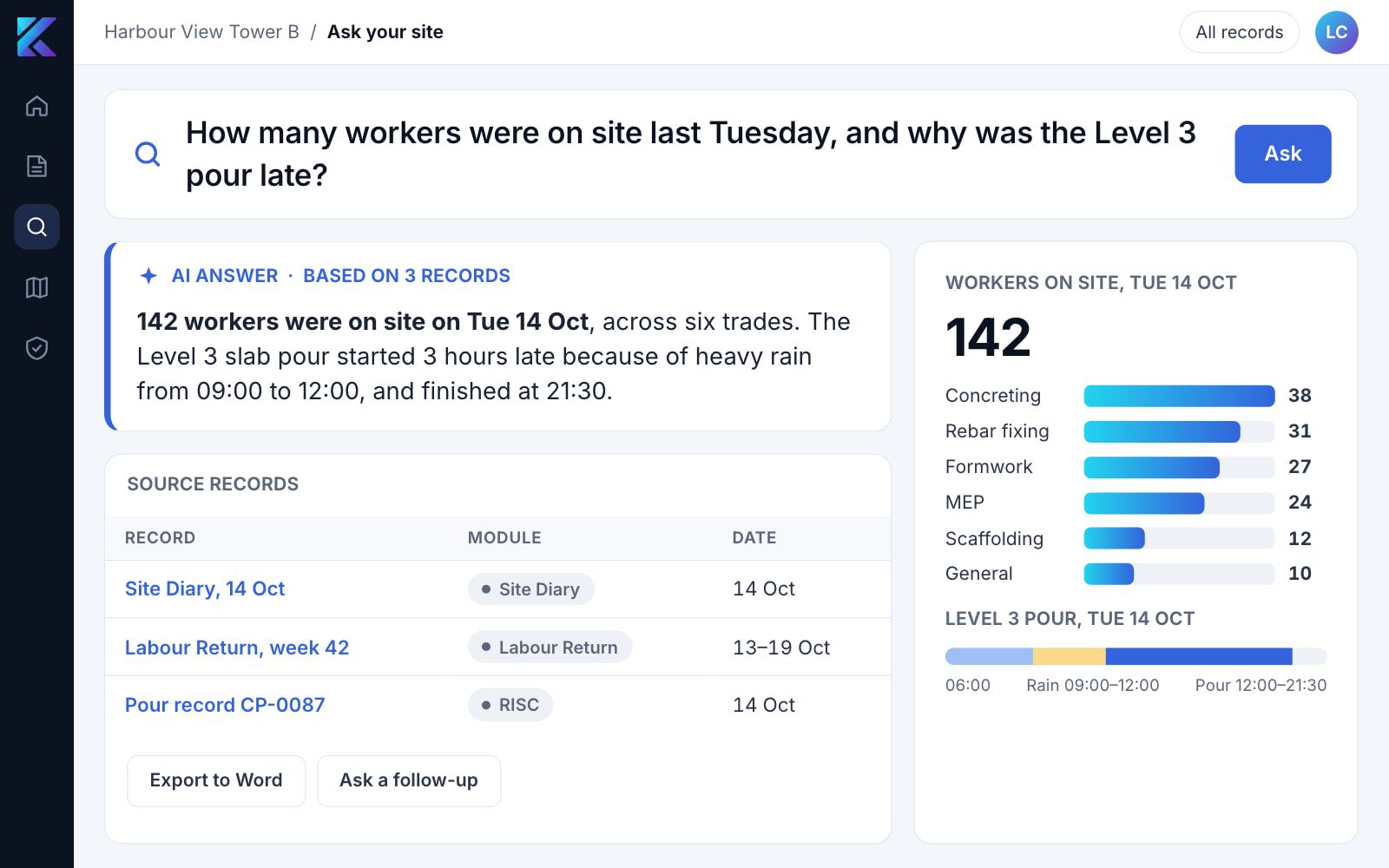
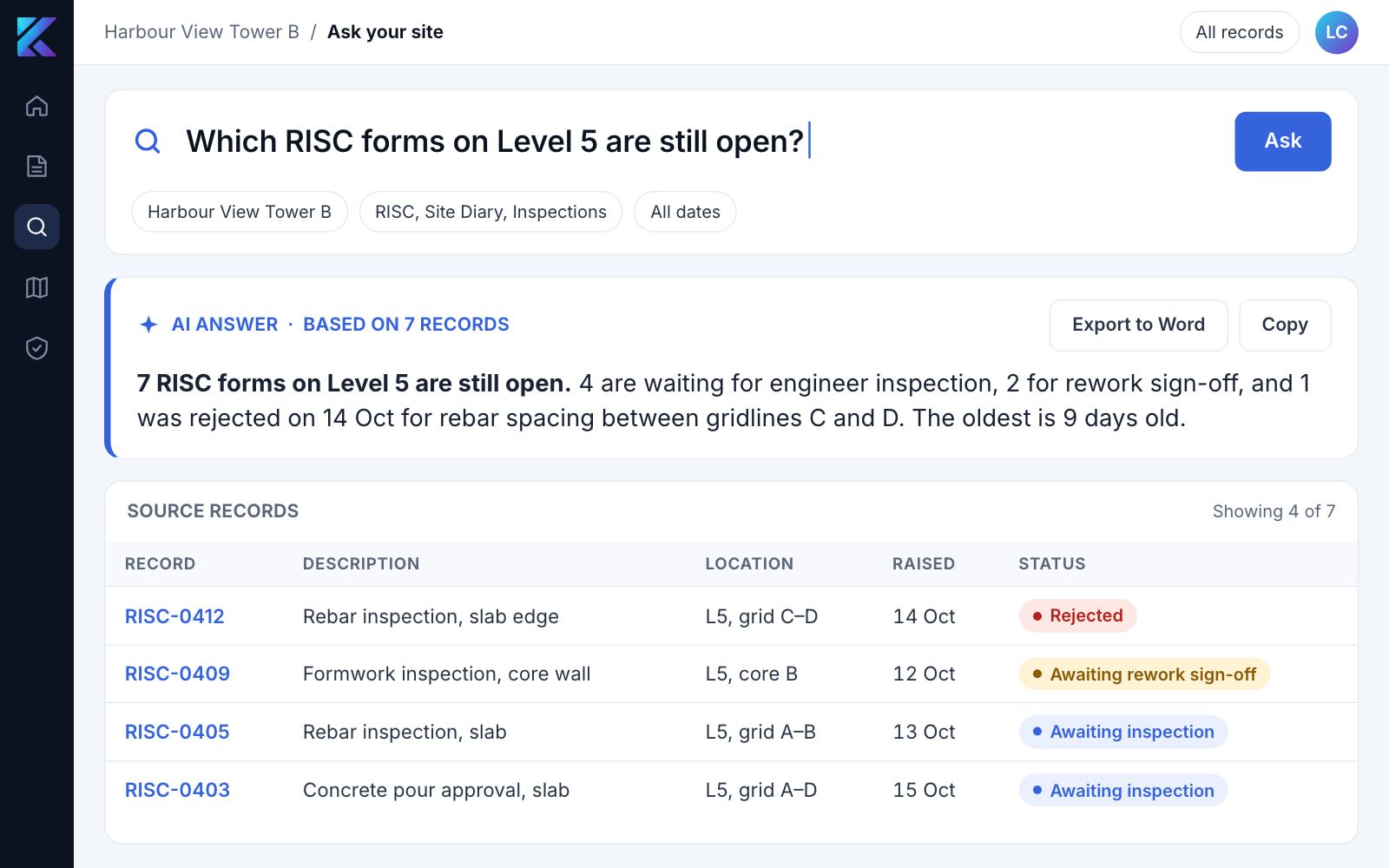
Ask your site records a question.
SpatialSense answers natural-language questions over your DWSS records and returns a table with links to the source records, so every answer can be checked.
Why SpatialSense for AI-3
What it does, and what it leaves to other tools.
AI-3, live
Natural-language search over your DWSS records, with desktop and mobile access and role-based access rights.
Answers you can check
Every answer comes with links to the source records, so a reviewer can verify it.
Clear about the limits
Report export to Word is partly covered, and AI-1 design optimisation and AI-2 tender checking are different tools that SpatialSense does not provide.
The requirement at a glance
- Circular
- DEVB TC(W) No. 3/2026, issued 4 March 2026.
- Consultancies
- Pre-tender estimate above HK$15 million, with Expression of Interest or Technical and Fee Proposal for a one-stage process, invited on or after 1 June 2026.
- Works contracts
- Pre-tender estimate above HK$30 million, tendered on or after 1 June 2026.
- Earlier contracts
- Implement the AI adoption as far as practicable.
- Other projects
- Subvented projects and projects entrusted to bodies such as the Airport Authority and MTR Corporation should follow the policy as far as practicable.
- Exemption
- An officer at D2 rank or above of the managing works department may exempt adoption on exceptional grounds, such as substantial impact on project delivery or projects of little technical content.
- Data protection
- Project offices must follow the Core Security Principles of the Baseline IT Security Policy and the six Data Protection Principles of the Personal Data (Privacy) Ordinance.
The Inventory in full
The Inventory is a living document that DEVB updates. This is the March 2026 issue (version 03/26).
| Ref | Use case | Baseline requirements (summary) | Outcome |
|---|---|---|---|
| AI-1 | Design optimisation, by AI or robotic process automation. In this issue, design of foundations and earth retaining structures. | Apply prevailing design codes, generate or evaluate options with generative or parametric algorithms, identify non-compliant elements with explanation, work across design software and support IFC for BIM, and automate documentation. | A Design Optimisation Report showing time saved and the enhanced utilisation rate, submitted as a consultancy deliverable. |
| AI-2 | Checking of tender documents | A retrieval-augmented generation (RAG) or equivalent framework over a version-controlled knowledge library, with user-managed content, omission and non-standard provision checks linked to sources, and import and export in formats such as MS Word. | A summary submitted with the completed tender document showing how the checking assistant was used. |
| AI-3 | Information retrieval and reporting from the Digital Works Supervision System | Access to DWSS data, natural-language search by RAG or equivalent, concise summaries with links to sources, template-based reports exportable to MS Word, desktop and mobile access, and role-based access rights. | A summary of the reports and analysis produced with the assistant, submitted as an annex to the progress report. |
How this connects to the DWSS
Annex A, 1.5 of TC(W) No. 8/2025 says contractors incorporate appropriate AI technologies within the DWSS and document them in the proposal, with the Inventory setting the mandatory requirements.
AI-3 is the Inventory use case that works on DWSS data, so a project office writing a DWSS specification now should read both circulars together.
AI adoption questions
What is AI-3?
AI-3 is the use case in DEVB's Inventory for information retrieval and reporting from the Digital Works Supervision System. It asks for access to DWSS data, natural-language search by retrieval-augmented generation or equivalent, concise summaries with links to sources, template-based reports exportable to MS Word, desktop and mobile access, and role-based access rights.
Is AI adoption mandatory?
Yes for qualifying contracts. Consultancies above HK$15 million and works contracts above HK$30 million invited or tendered on or after 1 June 2026 shall adopt AI technology as stipulated in the Inventory (paragraph 8).
Does SpatialSense provide AI-3?
Yes. SpatialSense answers natural-language questions over your DWSS records and links each answer to its source records. AI-1 and AI-2 are different tools, and SpatialSense does not provide them.
Can a project add its own AI requirements?
Yes. The employer may impose additional provisions or enhancements to the Inventory to address specific requirements, and project offices are encouraged to deploy other AI-related technology (paragraphs 10 and 11).
How is a contractor's AI proposal assessed?
The employer or client reviews and evaluates the consultant's or contractor's AI proposal against the baseline requirements in the Inventory before accepting it (paragraph 12).
What data rules apply?
Project offices must implement data security in line with the Baseline IT Security Policy and comply with the Personal Data (Privacy) Ordinance, including its six Data Protection Principles (paragraphs 14 and 15).
Ask how AI-3 applies to your DWSS
Tell us your contract and we will show you AI-3 on your kind of project.