
DEVB TC(W) No. 3/2023
Smart Site Safety System (4S), where SpatialSense fits
DEVB TC(W) No. 3/2023 requires a Smart Site Safety System on Hong Kong capital works contracts above HK$30 million. SpatialSense provides two of its components, the centralised management platform and the digitised permit-to-work. Device-based alerts need other equipment.
Other devices in, one safety dashboard out.
Wearables, cameras and machine-mounted detection come from other suppliers. SpatialSense brings their data together.
Other suppliers
Devices on site
- Wearables and helmets
- Cameras and sensors
- Machine-mounted detection
Centralised management
SpatialSense platform
- One data hub
- AI risk flags
- Digital permit-to-work
Safety dashboard
Your team
- Alerts and trends
- Reports for review
The 4S components, and where SpatialSense fits
The sample contract provisions in Annex A list these components. Project teams select the ones that suit the high-risk activities on site, and are not limited to the list (paragraph 9). Two are live in SpatialSense. The rest are devices from other suppliers. In the circular they send their data to the centralised management platform, which SpatialSense provides.
| Component | What the sample specification asks | In SpatialSense |
|---|---|---|
| Centralised management platform | A one-stop hub for data analysis, alerts and follow-up on hazards and abnormalities, with 99.9% uptime during working hours. It may be amalgamated with the DWSS to save cost (paragraph 5 and footnote 1). | Live |
| Digitised permit-to-work | Online application, issuance and tracking of permits for high-risk activities such as confined space, electrical, lift shaft, mobile plant, hot work, MEWP and lifting work, with real-time status on a mobile device and alerts when a permit expires. | Live |
| Digitised tracking of site plant and tools | A unique digital code on each plant, MEWP, lifting appliance, lifting gear and powered tool, scanned on a mobile device to show certification and maintenance records, with an alert when they are outdated. | Other supplier |
| Hazardous-area access control | An electronic lock and key system for hazardous areas, with an alert on unauthorised opening. | Other supplier |
| Mobile-plant danger-zone alert | Sensors on excavators and cranes giving 360 degree coverage of a danger zone generally not less than 2 m, with warnings to the operator and to the person entering. | Other supplier |
| Tower-crane lifting-zone alert | Warnings to people entering the lifting danger zone of a tower crane. | Other supplier |
| Smart monitoring devices for workers | Wristbands or helmets that track indoor and outdoor location and detect standstill, with alerts to the platform. | Other supplier |
| Safety monitoring using AI | IP cameras and AI processors that detect unsafe scenarios in real time, passing an accuracy test before use. | Other supplier |
| Confined-space monitoring | Headcount and location inside confined spaces, PPE checks, and gas, oxygen and temperature readings, with real-time alerts. | Other supplier |
| MEWP anti-entrapment monitoring | Smart monitoring system for Mobile Elevating Work Platforms, added in the update of 10 July 2026. | Other supplier |
| Scaffolding putlog monitoring | Smart monitoring system for scaffolding putlogs, added in the update of 10 July 2026. | Other supplier |
| Smart fire and smoke detection | Smart fire and smoke detection system, added in the update of 10 July 2026. | Other supplier |
Device-based components are supplied by other vendors, and SpatialSense does not provide them. Ask us which devices to specify alongside the platform.
Why SpatialSense for 4S
What SpatialSense does in a Smart Site Safety System, and where it stops.
Two components, live
The centralised management platform and the digitised permit-to-work are live in SpatialSense, not roadmap items.
Same system as your DWSS
The circular lets the centralised platform amalgamate with the DWSS to save cost. SpatialSense is built as a DWSS, so one system can serve both.
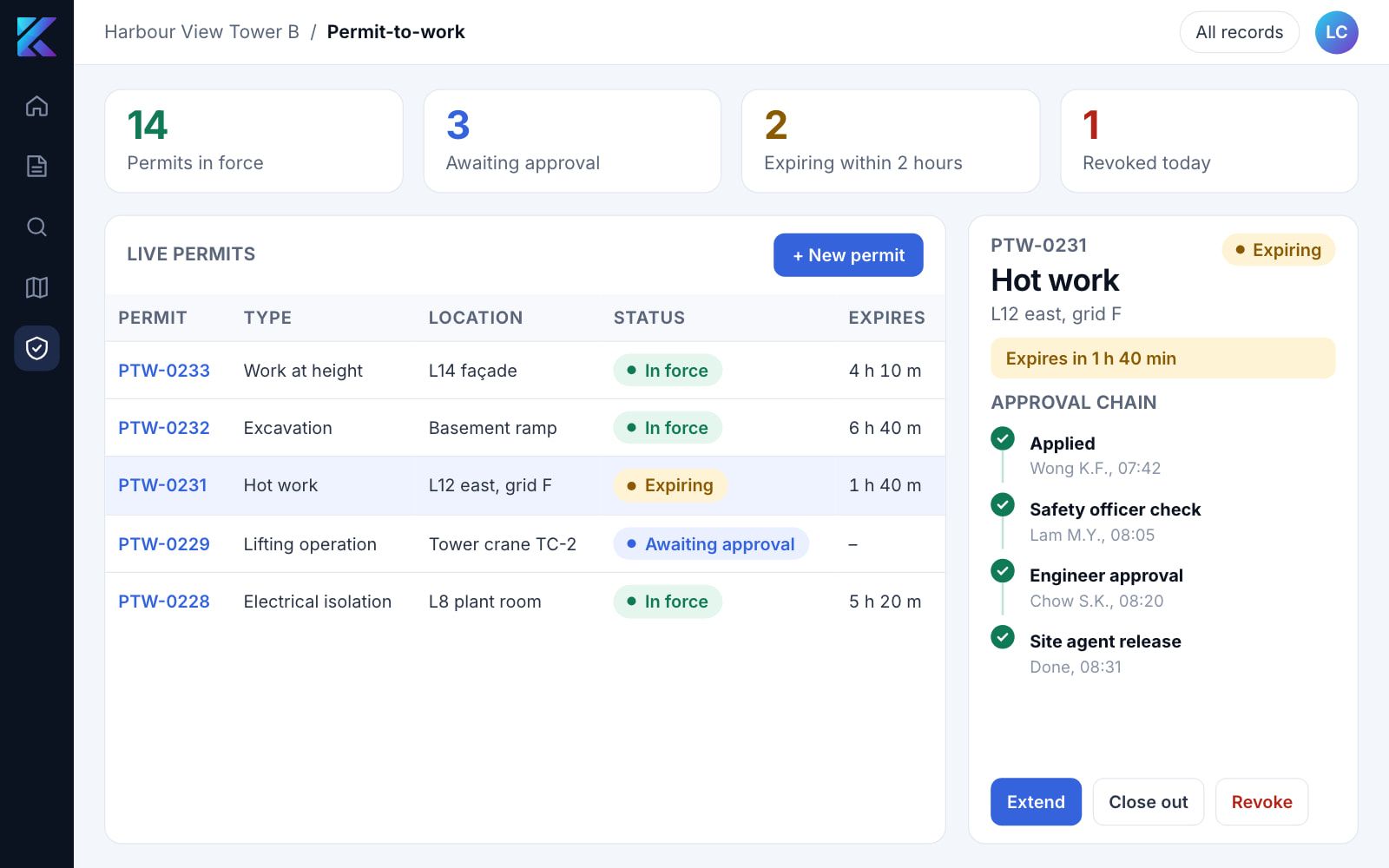
Permit-to-work, end to end
Raised on site, approved in order, watched with expiry alerts and seen on a live dashboard, for confined space, hot work, lifting and other high-risk activities.
A clear line on scope
We say which components we cover and which need another supplier's devices, so your specification and our proposal line up.
How permit-to-work runs in SpatialSense
The digitised permit-to-work is the part of 4S that SpatialSense runs end to end.
Raised on site
The permit is created where the work happens, with the work location attached.
Approved in order
The approval chain runs in sequence and cannot be skipped.
Watched while open
Expiry alerts warn before a permit lapses, and a permit can be revoked when conditions change.
Seen at a glance
A live dashboard shows every permit in force across the site.
The requirement at a glance
- Circular
- DEVB TC(W) No. 3/2023, issued 27 February 2023, to be read with the Construction Site Safety Manual and the DWSS circular.
- Must adopt
- Capital works contracts with an estimated contract sum above HK$30 million (paragraph 7).
- Other public works
- Since the memo of 10 July 2026, other public works contracts above HK$30 million, such as maintenance and term contracts, shall also adopt a Smart Site Safety System (paragraph 8).
- Three parts
- Smart safety devices for high-risk activities, a communication network, and a centralised management platform (paragraph 5).
- Cost guide
- Normally not more than HK$10 million or 1% of the estimated contract sum, whichever is lower. Going above it needs advice from the Departmental Safety and Environmental Advisor and approval at D2 rank or above (paragraph 10).
- Contractor performance
- A contractor's adoption, implementation and maintenance of the system is reflected in the Report on Contractor's Performance, through the Score Card for Assessment of Site Safety Performance (paragraph 13).
- Exemption
- The Head of a Works Department may exempt a contract on exceptional grounds, such as serious contractual implications or substantial impact on project delivery (paragraph 14).
Smart Site Safety System questions
What is the Smart Site Safety System (4S)?
Under DEVB TC(W) No. 3/2023, a Smart Site Safety System has three parts, smart safety devices for high-risk activities, a communication network, and a centralised management platform that gives a one-stop hub for data analysis, alerts and follow-up (paragraph 5).
Is SpatialSense a complete Smart Site Safety System?
No. SpatialSense provides the centralised management platform and the digitised permit-to-work. The device-based components, such as AI cameras, wearables, plant alerts and gas sensors, come from other suppliers.
Can the 4S platform and the DWSS be the same system?
The circular says that, for cost effectiveness, the centralised management platform may amalgamate with the Digital Works Supervision System (paragraph 5, footnote 1). SpatialSense is built as a DWSS.
Must a project use every component in the sample specification?
No. Project teams select suitable smart safety devices based on the nature of the works and the high-risk activities involved, and are not limited to those in the annexes (paragraph 9).
What does 4S cost?
The estimated cost would normally not exceed HK$10 million or 1% of the estimated contract sum, whichever is lower. It does not form part of the contract computer facilities estimate (paragraph 10).
What changed in July 2026?
The memo of 10 July 2026 extends the requirement to other public works contracts above HK$30 million, and adds smart monitoring for MEWPs, scaffolding putlogs, and fire and smoke detection to the contract provisions.
Tell us what your 4S specifies
Send us the components in your contract and we will show you which ones SpatialSense covers, and which need other equipment.